![brioHR-logo-color.svg]](https://support.briohr.com/hubfs/brioHR-logo-color.svg)
In Malaysia, employers may provide Travel or Petrol Allowances to employees to cover commuting, work-related travel, or petrol expenses. These allowances are typically offered as part of employment benefits.
BrioHR provides a dedicated payitem - Travel/Petrol Allowance (Official Duties) to ensure proper payroll management, statutory compliance, and tax reporting. This article explains how to use this payitem, when it applies, the tax relief limits, and how to enable the EPF contribution.
When to Use This Payitem
The Travel/Petrol Allowance (Official Duties) payitem should be used in the following situations:
-
Work-Related Travel
-
For employees using their personal vehicle for official work duties or business trips.
-
-
Commuting or Petrol Expenses
-
Employers may provide a fixed petrol/travel allowance to employees to cover commuting costs or work-related travel.
-
Tax Treatment and Relief
1. Taxable vs Non-Taxable
-
Travel/Petrol Allowances may be tax-exempt up to statutory limits, depending on Malaysian Inland Revenue Board (LHDN) regulations.
-
Any allowance exceeding statutory limits is considered taxable and must be included in the employee’s gross income.
2. Tax Relief Limit Example
-
Maximum tax-exempt relief for Travel/Petrol Allowance: RM6,000 per year per employee (as per LHDN limit).
-
Allowances exceeding RM6,000/year are taxable and included in payroll gross income.
EPF Contribution
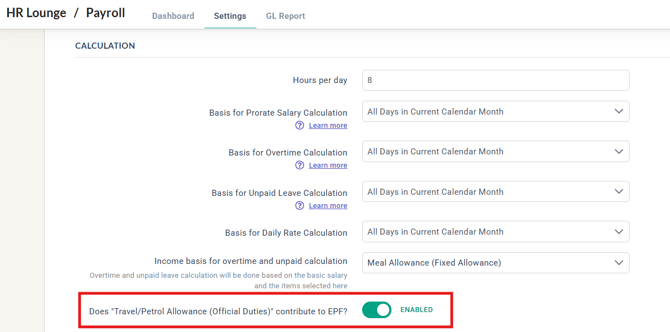
To enable the EPF contribution for this payitem, please refer to the steps below:
- Go to HR Lounge > Payroll.
- Click into Settings > General
- Scroll down to Calculation
- Enable the toggle for the setting 'Does Travel/Petrol Allowance (Official Duties) contribute to EPF?'
- Scroll down to the bottom of the page and click Save
NOTE:
If the Payroll Cycle is Reopened after this setting has been enabled, this will trigger a refresh within the payroll cycle.
Key Points to Know
1. Statutory Compliance
-
Verify allowances are within statutory tax-exempt limits.
-
Misapplication may result in incorrect tax reporting or LHDN non-compliance.
2. Payroll Treatment
-
Non-taxable allowance (≤ RM6,000/year) does not affect taxable income.
-
Taxable allowance (> RM6,000/year) is included in gross income and subject to EPF contribution.
3. EA Form Reporting
-
Non-taxable allowance is excluded from taxable income in the EA Form.
-
Taxable allowance is included in EA Form under the appropriate income category.
Need Assistance?
If you have any questions or require assistance, please reach out to our support team via live chat or email us at support@briohr.com.