![brioHR-logo-color.svg]](https://support.briohr.com/hubfs/brioHR-logo-color.svg)
Why Do You Need to Create a Custom Pay Item?
In BrioHR, there is a default list of available pay items set according to local statutory rules and regulations. However, there may be times when you need to create a custom item because you cannot edit the existing default item to fit your company's specific processes.
Therefore, creating a custom pay item is your only option to address this situation.
NOTE:
Before creating a custom payslip item to use in payroll, it is advisable to check if similar items already exist in the Default Payslip Items list provided by BrioHR.
1. Once logged into your BrioHR account, click on the HR Lounge icon and select Payroll.
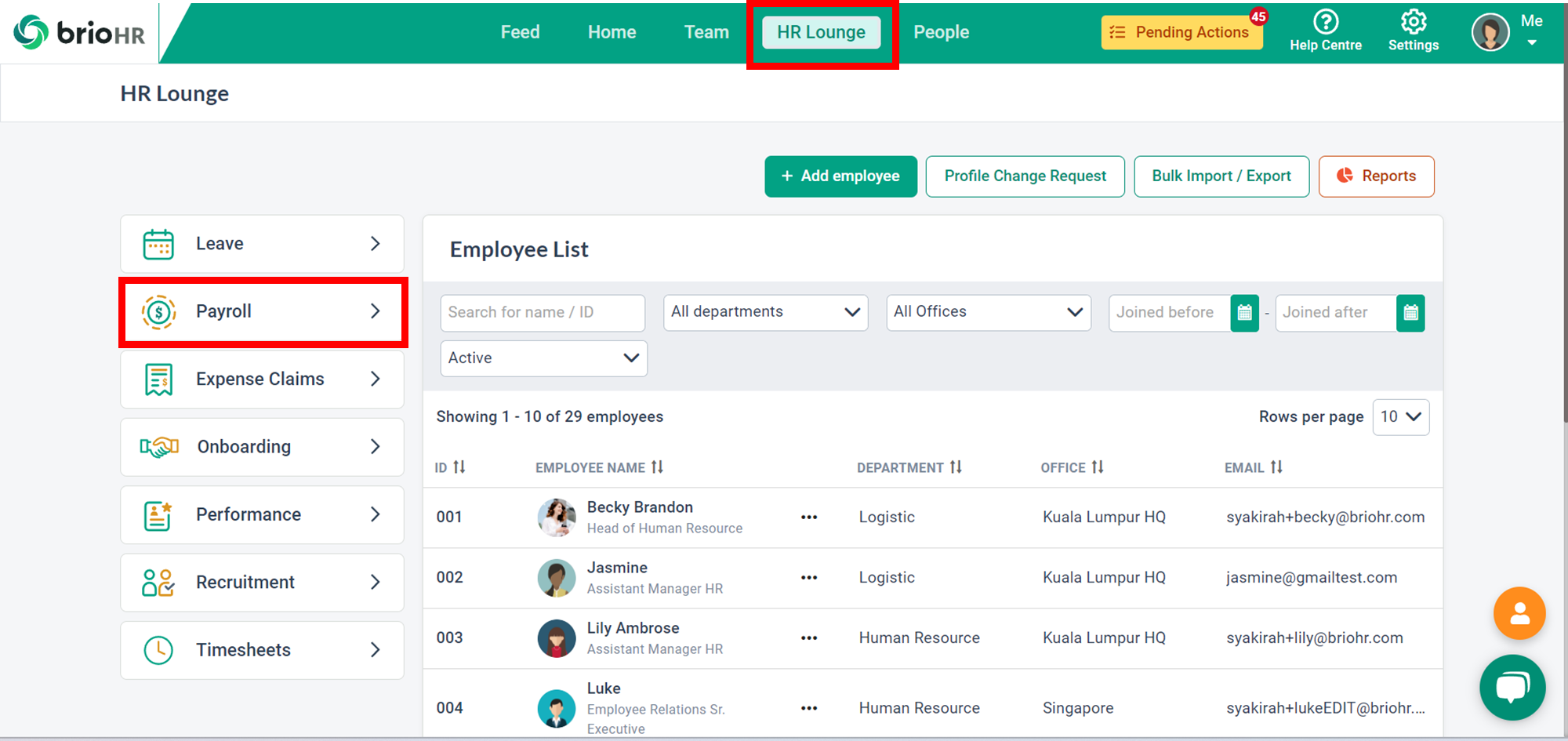
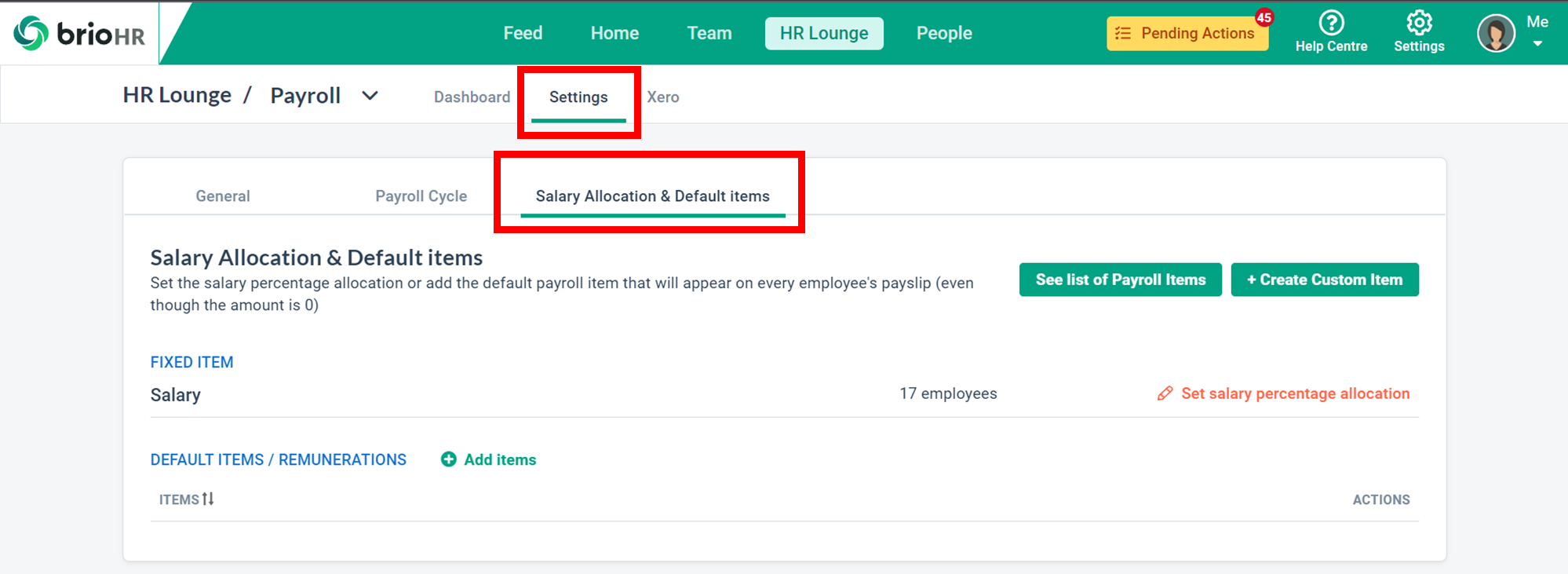
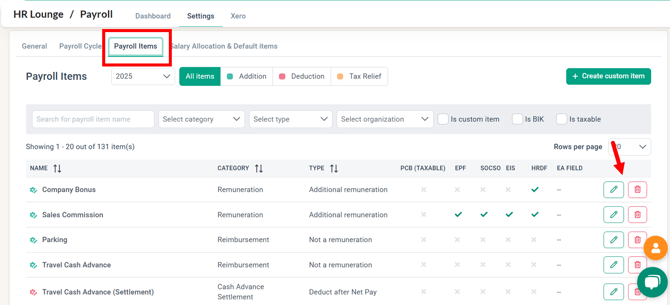
2. Next, click on Settings and select the Payroll Items field.
3. Click on the +Create Custom Item icon as shown below.

4. A pop-up (Create Custom Item) will appear. Fill in all the relevant fields and click Submit to save your changes.
- Item name: This name will be used in payroll reports and employee payslips.
- Item type: Choose Addition (will be paid out) or Deduction (will be deducted from pay)
- Category:
- Addition
- Allowance
- Remuneration
- Other perquisites
- Benefit-in-Kind
- Reimbursement (used to reimburse claims items to employees)
- Deduction
- Deductions
- Cash Advance Settlements (used to deduct unutilized cash advances, related to expense claims module, to employees)
- Addition
- Addition/Deduction type: -
- Malaysian payroll
- Addition (remuneration type can affect statutory calculations)
- Fixed remuneration
- Additional remuneration
- Not a remuneration
- Deduction
- Deduct after Gross Pay
- Deduct after Net Pay
- Addition (remuneration type can affect statutory calculations)
- Singapore payroll
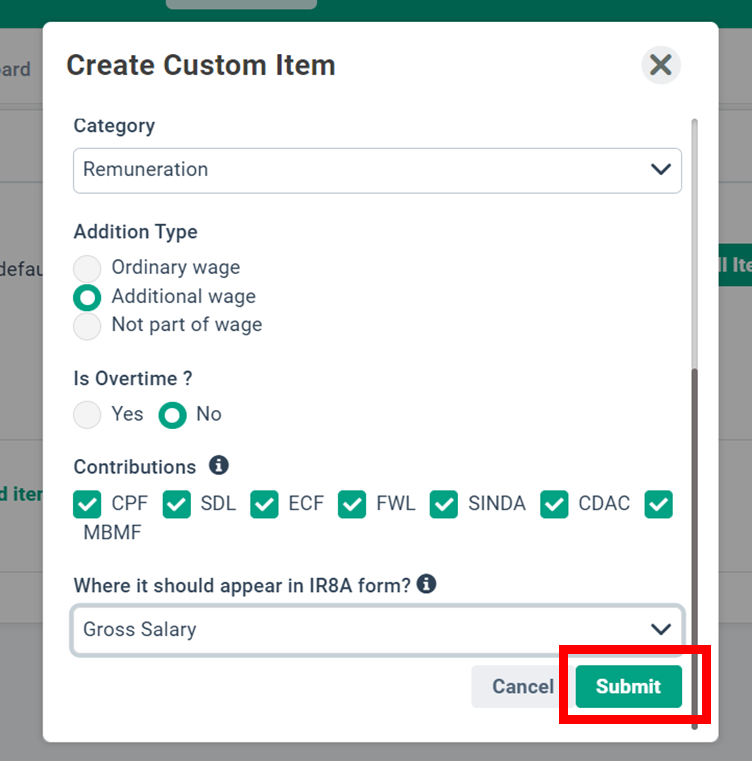
- Addition (wage type can affect statutory calculations)
- Ordinary wage
- Additional wage
- Not part of wage
- Deduction
- Deduct after Gross Pay
- Deduct after Net Pay
- Addition (wage type can affect statutory calculations)
- Malaysian payroll
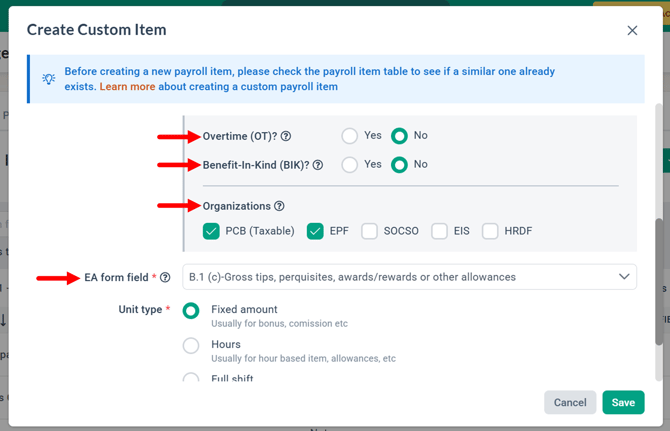
- Organizations: Selecting an organization includes the item in its statutory contribution calculations.
- Malaysian payroll
- PCB (Potongan Cukai Bulanan) - Monthly tax deduction
- EPF (KWSP, Kumpulan Wang Simpanan Pekerja) - Employee Pension Fund
- SOCSO (PERKESO) - Social Security Organization
- EIS (Employment Insurance System)
- HRDF (The Human Resources Development Fund)
- Singapore payroll
- CPF (Central Provident Fund)
- CDAC (Self Help Group Fund-Chinese Development Assistance Council)
- ECF (Self Help Group Fund-Eurasian Community Fund)
- MBMF (Self Help Group Fund-Mosque Building and Mendaki Fund)
- SINDA (Self Help Group Fund-Singapore Indian Development Association)
- SDL (Skills Development Levy) - usually paid together with CPF
- FWL (Foreign Worker Levy)
- Malaysian payroll
- EA/IR8A for field
- Choose where this pay item will be mapped (added to) in the EA/IR8A form. Choose the 'Not applicable' option if it does not need to be included in EA/IR8A reporting.
IMPORTANT:
-
Ensure you select the correct options when creating a custom payslip item. Choosing the wrong option may affect payroll calculations.
-
The Admin/Payroll Manager of your company is responsible for deciding which statutory contributions apply based on the nature of the payment.
-
It is not the responsibility of brioHR to check the settings applied for your company payroll.
-
For pay items with unclear statutory treatment, always confirm with the relevant statutory body or a payroll consultant. brioHR cannot provide statutory advice.
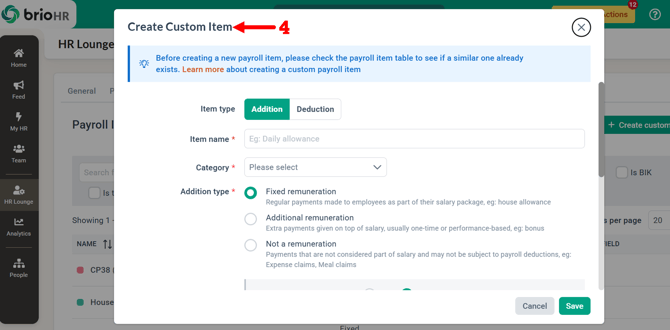
Sample of Custom Item format for Malaysia Payroll
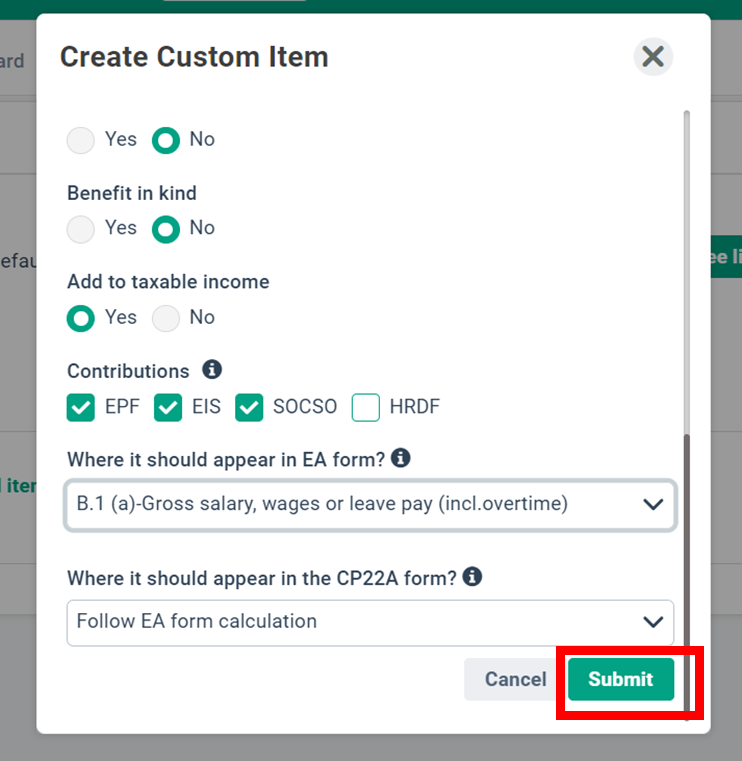
Sample of Custom Item format for Singapore Payroll
Unit Type Explained: Fixed, Hours, Shift & Days
This new “Unit Type” feature allows HR to configure pay items based on different unit types.
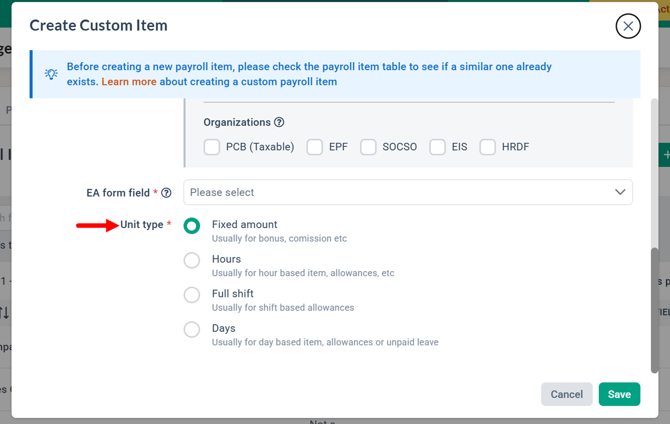
1. Fixed Amount: Enter a fixed amount manually (e.g., RM 200, $200)
2. Hours: Ideal for hour-based pay items. Two options are available:
- Employee’s Hourly Rate
- The amount is calculated based on the employee’s hourly or monthly salary. You may also apply a multiplier (e.g., x1).
- Example:
Employee’s hourly rate is $30.
If 3 hours are entered in payroll with a multiplier of 1: 3 hours x $30 x 1 : $90
- Fixed Rate per Hour
- Set a fixed hourly rate.
- Example: $10/hour
3. Full Shift : Best used for shift-based allowances.
- Set a fixed amount to be paid per shift.
- Example: $20/shift
4. Days: Used for day-based pay items. Two options are available:
- Employee’s Daily Rate
- The amount is calculated based on the employee’s monthly salary.
You must first configure the [basis of daily rate calculation]. - A multiplier can also be applied (e.g., x1).
- Example:
Monthly salary = $3,000
Daily rate = $90
If 5 days are entered with a multiplier of 1: 5 days x $90 x 1 : $450
- The amount is calculated based on the employee’s monthly salary.
- Fixed Rate per Day
- Set a fixed daily rate.
- Example: $80/day
Modify and Delete Custom Pay Item
To view the list of custom pay items, go to the Payroll Items table.
Customized pay items will appear at the top of the table.
-
Pencil icon: Click to edit the custom pay item. Changes will only take effect in future payroll cycles. If the pay item has already been used in past payroll months, the modifications will not be applied retroactively.
-
Bin icon: Click to remove the custom pay item.
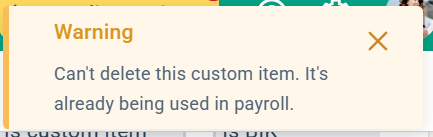
CAUTION:
You cannot remove a custom pay item that has been used in past payrolls. A warning message will appear, as shown below.
Common Issues / FAQ
Q: My staff has a BIK (benefit in kind) — how do I include it in the PCB deduction?
When creating the custom pay item, use the BIK and PCB select options in the Create Custom Item pop-up — the contribution is captured through the pay item's own configuration. Review the item's statutory options (PCB, EPF, SOCSO, EIS, HRDF) before running payroll: the deduction treatment always follows the item's settings.
Need Assistance?
If you have any questions or require assistance, please reach out to our support team via live chat or email us at support@briohr.com.